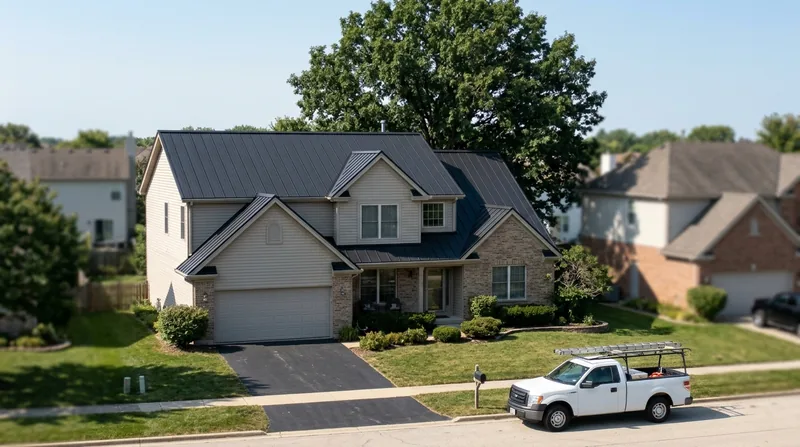




Standing Seam Metal Roofing in Aurora: Concealed Fasteners, Clean Snow Shed, No Backed-Out Screws
If you own a home in Aurora, you already know what the weather does to a roof. The Fox River funnels cold air through downtown and the islands around Stolp Island, and the flat prairie farmland west of town gives straight-line wind and hail a clean run at every gable and ridge. Standing Seam Metal Roofing in Aurora is the system we install most on steep Victorian and Queen Anne roofs on the Near East Side, on Craftsman bungalows and brick Tudors on the West Side, and on the big two-story subdivision roofs out in Stonebridge and Oakhurst. The panels are roll-formed to length, then mechanically seamed or snap-locked, so there are no exposed screws to back out as January cold and July heat work the metal. Snow sheds cleanly off the seams instead of sitting and refreezing into ice dams at the eave. If you are weighing this against a full tear-off, start with our metal roof installation page, then come back here for the standing seam specifics.
Why Standing Seam Makes Sense on Aurora Roofs, From the River to the Prairie Edge
Aurora's housing stock puts a lot of steep, cut-up roof planes in front of us. The 1880s to 1920s Victorians and Italianates around downtown have dormers, turrets and valleys that eat shingles alive. The 1950s to 1970s ranches and split-levels in Phillips Park and the south side have low pitches where wind-driven rain and old ice dams have already done damage. Standing seam handles both because the panel runs long and the fastener hides under the seam.
- You get concealed fasteners that cannot back out, which is the single biggest failure we see on exposed-screw roofs after a hard Aurora winter.
- The panels resist straight-line wind gusts that peel shingle tabs off the west-facing slopes out toward Sugar Grove and Montgomery.
- Snow slides off the smooth seams instead of building up and refreezing at the gutter line, which cuts ice dam risk on north slopes that stay shaded for months.
- You get a 40 to 70 year service life on painted steel, so the roof outlasts two or three shingle cycles on the same house.
- The clean vertical lines suit Victorian and Italianate fronts without the busy texture of shingles.
For the older homes near the river, the payoff is fewer callbacks on the dormers and valleys, which is where shingle roofs fail first.
Key info: On a Queen Anne on Aurora's Near East Side, the front turret and three dormers create six small roof planes. Standing seam panels can be run continuous over most of that geometry, which removes the shingle-to-flashing joints where ice dams start. On a low-pitch ranch in Phillips Park, the same system lets us hit the 3:12 minimum with a mechanical seam instead of a shingle underlayment stack.
If you want to check what your own municipality requires before you commit, the City of Aurora building department is the authority on permits and inspection thresholds, and those rules can change, so verify with them directly.
How We Install Standing Seam in Aurora, Step by Step
Standing seam is not a drop-and-screw product. The panels are formed to the exact length of each run, so the measuring happens before anything goes on the truck. On a typical Aurora job we start with a full tear-off or a deck assessment, then work up from the underlayment. Here is the sequence we follow on a house in North Aurora or out in Eola.
- We measure every roof plane and roll-form the panels to length at the site or in the shop, so there are no lap joints mid-slope.
- We strip the old roof to the deck and replace any soft sheathing, which is common on 1920s bungalows that have seen a few leak cycles.
- We install a high-temp ice and water shield at the eaves and in the valleys, then a synthetic underlayment across the field.
- We set the eave trim and the first panel, then check the seam line against the ridge before we commit the rest of the run.
- We mechanically seam or snap-lock each panel and fasten the clips to the deck, keeping the fasteners hidden under the seam.
- We cut and fit the ridge, hip, and sidewall flashings, then seal the penetrations at chimneys and skylights.
- We walk the roof, check every seam and termination, and clean the gutters and ground before we leave.
The whole point of that order is that the flashing and the panel line get checked before the next run covers them, which is where most standing seam leaks originate.
Key info: On a two-story in Stonebridge with a long south-facing run, we roll-formed the panels in one continuous piece from eave to ridge, roughly 22 feet, so there is no horizontal lap for snowmelt to find. On a Craftsman bungalow on the West Side, the porch roof and the main roof meet at a low valley, so we ran the ice and water shield 36 inches up both sides before the panels went down.
If your roof has a chimney, skylight, or a tricky sidewall transition, the flashing detail matters as much as the panel, and our flashing, chimney and skylight repair page covers how we handle those junctions.
Standing Seam Approaches We Use on Aurora Homes
Not every Aurora roof wants the same seam. The profile, the seam type, and the panel width all change with the pitch, the architecture, and how much snow you need to shed. Here is how we match the approach to the house.
| Approach | Description | Best for |
|---|---|---|
| Mechanically seamed | The seam is folded closed with a powered seamer after the panels are set, giving the tightest, strongest joint. | Low pitches down to 2:12 and any roof that takes full wind and snow load. |
| Snap-lock | The panel edges snap together over a concealed clip, with no mechanical seamer needed. | Steeper pitches on Victorians and bungalows where the seam profile stays visible. |
| Batten or high-seam profile | A taller seam line that reads more strongly from the street and sheds snow faster. | Italianate and Queen Anne fronts where the roofline is part of the architecture. |
| Narrow 12-inch panel | More seams per square, which lets us work around dormers and turrets with less waste. | Cut-up roofs on older homes with many small planes and valleys. |
| Wide 16 to 18-inch panel | Fewer seams and a cleaner field, with faster coverage on large open planes. | Big subdivision roofs in Oakhurst and Fox Valley with long uninterrupted runs. |
We pick the profile with you, not for you, because the seam you see from the curb is a design decision as much as a performance one.
Standing Seam Metal Roofing Cost in Aurora: What to Expect
Standing seam is the premium metal option, and the price reflects it. In the Aurora market, plan on a starting point of From $10/sq ft installed, with most full residential jobs landing in a range above that once you account for tear-off, deck repair, and the complexity of the roof. A simple gable on a ranch is at the low end. A Victorian with a turret, three dormers, and a dozen valleys is at the high end, because every one of those transitions costs labor and material.
The factors that move the number are predictable. Roof pitch and height matter, since a steep two-story in Stonebridge takes more staging and fall protection than a single-story ranch. Access matters, and a tight lot near downtown with a fence and a garage in the way costs more than an open lot on the prairie edge. Deck condition matters, because soft sheathing on a 1920s bungalow has to be replaced before the panels go down. Panel width, seam type, and color finish all move the per-square figure, and so does the gauge of steel you choose.
Getting two or three written estimates is the smart move, and not just to find the lowest number. You want to compare what each contractor includes for tear-off, underlayment, flashing, and disposal, because a low bid that skips the ice and water shield is not a low bid at all. Our full pricing overview shows how the line items break down so you can compare apples to apples.
What to Look for in a Standing Seam Metal Roofing Contractor Near Me in Aurora
Standing seam is a specialty trade, and not every roofer who hangs shingles can roll-form and seam a panel correctly. When you are sorting through contractors near Aurora, the basics come first. Confirm the license and the insurance, and ask for a certificate of insurance before anyone gets on your roof. Get at least two or three written estimates with the same scope so you can compare them honestly. Ask for local references on standing seam jobs, not just shingle jobs, and call them.
Then check the details that matter on your specific house. If you are in a historic district near downtown, design review can restrict panel profile and color, so ask the contractor whether they have worked inside those rules before. If your subdivision has an HOA, get the architectural approval in writing before the panels are ordered. And confirm who pulls the roofing permit, because thresholds and inspection requirements vary by jurisdiction and the local building department has the final say.
If you want to talk through your roof and get a straight answer on whether standing seam fits it, contact us for a free estimate. We will tell you what the roof needs and what it does not.
Standing Seam Metal Roofing in Aurora: Pricing Guide
| Service | Price | Details |
|---|---|---|
| Standing seam, simple gable roof | Starting at $10/sq ft | Includes tear-off, underlayment, panels, and standard flashing on an accessible single-story roof. |
| Standing seam, cut-up or steep roof | Starting at $14/sq ft | Dormers, turrets, valleys, and steep pitches add labor, staging, and waste on Victorian-era homes. |
| Standing seam over existing deck with repairs | On estimate | Soft sheathing, fascia rot, or prior leak damage must be opened and inspected before a number is firm. |
| Complex or large-scale job | On estimate | Multi-plane roofs, historic district review, or HOA approval need an on-site look before pricing. |
| Travel | Included | In Aurora and surrounding areas, no separate call-out or mileage fee. |
| Estimate | Free | Response within 24h at (331) 336-1471, no obligation to book. |
Indicative pricing, the exact cost depends on square footage, finish, and site access. Free personalized estimate within 24h at (331) 336-1471.


